 Skip to content
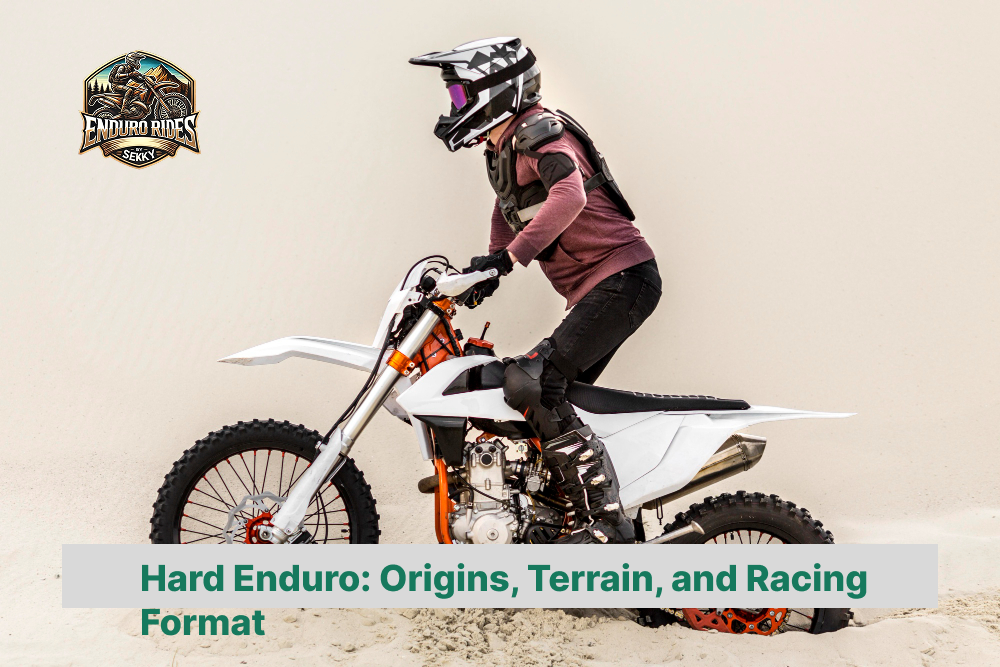
Hard enduro is an extreme motorcycle sport held on natural terrain such as mountains, forests, and rivers. It evolved from classical enduro in the early 2000s and features races like Red Bull Romaniacs, Erzbergrodeo, and Sea to Sky. Riders face steep climbs, rocks, and mud under timed stages that test both physical endurance and machine control.
- What is hard enduro?
- How is hard enduro different from regular enduro?
- What makes hard enduro one of the toughest motorcycle sports?
- Who can participate in hard enduro races?
- What are the main rules of hard enduro competitions?
- How to train for hard enduro?
- What are the best bikes for hard enduro?
- How do you ride on rocky terrain in hard enduro?
It differs from regular enduro through harsher terrain, slower speeds, and higher technical difficulty. While enduro uses smoother trails, hard enduro requires precision on obstacles like boulders, rivers, and logs. Bikes such as KTM 300 EXC and Husqvarna TE 300 are lighter and optimized for torque and traction.
Races last four to six hours with no external help, demanding focus, stamina, and navigation skill. Training builds balance, clutch control, and terrain adaptation. Riders use reinforced bikes and full protective gear to handle impact and fatigue.
Top terrains include Tara Canyon in Montenegro, Zlatibor in Serbia, Prenj in Bosnia, and Šar in North Macedonia. In Central Bosnia, Uskoplje offers trails with rocky climbs and forest paths used for local enduro events.
What is hard enduro?
Hard enduro racing takes place in natural terrain without artificial tracks. The events include famous races such as Red Bull Romaniacs in Romania, Erzbergrodeo in Austria, and Sea to Sky in Turkey. These races test physical stamina and mental focus through continuous climbs, sharp descents, and narrow forest sections. Hard enduro uses time as a performance constraint, terrain as a type constraint, and mechanical setup as a relationship constraint between rider and machine.
The sport emerged from classical enduro racing in the early 2000s and developed as a separate discipline focused on “extreme” off-road challenges. Each event includes stages, checkpoints, and timed sectors where riders are evaluated based on completion rate and penalty deductions. Examples of obstacles include rocky staircases, deep mud pits, and fallen logs that require high skill levels.
Riders often prepare through specific training that improves clutch control, low-speed maneuvering, and tire pressure management. Motorcycles such as the KTM 300 EXC and Husqvarna TE 300 are most frequently used due to their torque and lightweight construction. The relationship between rider skill and mechanical adaptation determines success, particularly on prolonged climbs or during technical sections.
How is hard enduro different from regular enduro?
Hard enduro is a more extreme variation of enduro racing. It differs from regular enduro by terrain type, physical intensity, and technical demands. Hard enduro courses feature rocks, rivers, logs, and steep climbs that require precise throttle control and body balance. Regular enduro uses smoother forest trails, dirt roads, and longer time sections that favor rhythm and speed consistency.
Hard enduro tests the rider’s ability to manage slow-speed technical control on natural obstacles. Events such as Red Bull Romaniacs and Erzbergrodeo include elevation gains above 1,500 meters and sections requiring engine torque at low gear ratios. These races demand physical endurance and mechanical adaptation. Hard enduro motorcycles are lighter, with reinforced skid plates and specialized gearing designed for traction.
Regular enduro focuses on overall speed and timed navigation. Riders compete on marked tracks through woods, gravel roads, and hill sections. Common events include the EnduroGP series and the International Six Days Enduro. Bikes feature long-travel suspension, stronger cooling systems, and setups for consistent lap pacing. The main differencebetween hard and regular enduro remains the environmental severity and rider endurance threshold.
What makes hard enduro one of the toughest motorcycle sports?
Hard enduro is one of the toughest motorcycle sports because riders climb vertical rock faces, cross rivers with strong current, and push bikes over fallen trees for 4 to 6 hours without breaks. Riders complete courses that include slippery mud, deep water, loose stones, and technical climbs on mountains. Events such as Red Bull Romaniacs and Erzbergrodeo prove difficulty through altitude gain, terrain instability, and race duration under extreme physical load.
Hard enduro routes combine man-made and natural obstacles in consecutive sections. Obstacles include boulder gardens, steep root sections, and ravines filled with rainwater. Each rider carries their own gear and tools without external help. The terrain changes constantly from forest paths to rocky cliffs. Riders lose balance while crossing logs or shifting gears on vertical climbs. The word “tough” reflects the cumulative effect of constant resistance from both the terrain and the machine.
Events extend beyond five hours under continuous engine heat and muscle fatigue. Motorcycles heat to over 100°C during uphill throttle pushes. Riders sweat through multi-layered protection such as neck braces, chest armor, and reinforced boots. Elevation often exceeds 1,500 meters on mountain routes. Riders descend sharp slopes with only back brake control and hand grip. Difficulty increases during rain when surfaces turn to clay and visibility drops below five meters.
Race formats demand mental focus and decision-making under exhaustion. Navigation depends on limited markers, GPS signals, or faint tire tracks. Riders memorize obstacle patterns and calculate throttle timing while jumping over rocks. One mistake on wet surfaces forces full resets that cost minutes. Events like Sea to Sky or Roof of Africa include sections where riders descend cliffs with bikes roped manually. Every meter involves physical effort and terrain negotiation, even when engines stall or bikes fall flat.
Who can participate in hard enduro races?
Anyone with a valid motorcycle license, proper safety gear, and physical endurance can participate in hard enduro races. Riders must register under an official event organizer and meet technical inspection standards for motorcycles before competing. Participation is open to both amateur and professional riders, with race categories divided by experience and engine class.
Hard enduro races are designed for riders who manage difficult terrain using advanced control and endurance. The race includes steep climbs, rocky descents, and river crossings that test rider skill and motorcycle durability. Riders such as Graham Jarvis, Mani Lettenbichler, and Billy Bolt represent professional instances of competitors who meet extreme performance criteria.
Participation in hard enduro events requires compliance with event regulations. Each participant must submit a medical certificate and hold a racing license issued by national or international federations like FIM or AMZS. Events such as Red Bull Romaniacs, Erzbergrodeo, and Sea to Sky accept registered riders across multiple classes including Bronze, Silver, and Gold. Examples after plural nouns are races such as Red Bull Romaniacs, Erzbergrodeo, and Sea to Sky.
Safety and endurance remain central attributes of participation. Riders use full protective equipment such as helmets, knee guards, and neck braces to reduce risk. Physical preparation includes endurance training, off-road navigation, and mechanical knowledge. Conditional phrasing is added naturally — participation may depend on age or license category defined by the organizing federation.
What are the main rules of hard enduro competitions?
Hard enduro competitions follow strict rules that regulate time, checkpoints, machine class, and rider conduct. Riders complete extreme off-road courses marked by natural obstacles such as rocks, rivers, and steep climbs. Time limits are enforced, and missing a checkpoint or external assistance during a timed section results in penalties or disqualification.
Each hard enduro event has a defined start and finish, with riders starting in intervals to reduce congestion. The course is divided into timed and liaison sections. Timed sections determine ranking, while liaison sections allow transition between checkpoints. Checkpoints, such as control points or GPS-verified waypoints, confirm progress and ensure route accuracy. Riders complete these checkpoints within a time window, such as 15 or 30 minutes depending on race type. Missing a checkpoint adds fixed penalty minutes, such as 30 or 60, depending on regulation severity.
Motorcycles are categorized by engine displacement and configuration, for example 2-stroke 300cc and 4-stroke 450cc classes. Bikes must comply with noise and environmental standards such as FIM environmental code. Riders equip mandatory safety gear including helmet, boots, gloves, goggles, and back protector. Failure to wear complete gear during timed sections causes exclusion from results. Riders are responsible for machine condition and refueling during designated service zones only.
Sportsmanship is mandatory during all sections. Riders avoid interference with competitors and follow marshal instructions. Assistance from other riders is allowed in specific zones, such as river crossings or rock climbs, but mechanical help from spectators or crews is forbidden in timed stages. Dangerous riding or shortcutting leads to disqualification. Medical checks and transponder tracking ensure safety and course compliance.
How to train for hard enduro?
Hard enduro training is the development of technical riding skills, physical endurance, and terrain adaptability. The core of training is divided into three parts: motorcycle control, physical conditioning, and terrain practice. Motorcycle control covers clutch modulation, balance, and throttle precision. Physical conditioning improves muscle endurance and cardiovascular capacity. Terrain practice increases adaptability on rocks, roots, and steep climbs.
Riders perform interval sessions to increase anaerobic capacity and simulate race fatigue. Strength training focuses on grip endurance, forearms, and core muscles. Balance drills use low-speed maneuvers and obstacles such as logs or tires. These drills create adaptation between rider and motorcycle. Riders practice recovery positions and line selection to maintain rhythm on extreme terrain.
Training includes repetition on natural obstacles such as boulders, streams, and mud sections. Skill reinforcement occurs when techniques are repeated under fatigue. Weekly riding frequency ranges between 4 to 6 sessions, depending on race schedule. Progress is measured by maintaining pace through long uphill sections. Training consistency determines overall race endurance if the load is periodized correctly.
What skills are needed for hard enduro riding?
Hard enduro riding requires advanced balance control, clutch precision, throttle modulation, and physical endurance.
Balance control stabilizes the motorcycle across obstacles like rocks, roots, or steep slopes. Clutch precision regulates torque delivery when traction is minimal. Throttle modulation synchronizes engine response with terrain resistance. Physical endurance sustains consistent control through prolonged technical sections. Core strength, forearm conditioning, and cardiovascular fitness maintain precision under fatigue.
Mental focus determines error recovery speed and terrain adaptability.
Hard enduro riders analyze obstacles in real time and choose micro-lines within seconds. This requires spatial awareness and reaction accuracy. Terrain reading involves visual mapping of traction zones and mechanical limits. Experience in variable conditions such as mud, loose gravel, or slippery logs builds predictive control. Decision execution under pressure defines mastery, especially during races like Erzbergrodeo or Romaniacs.
Technical skill integrates braking control, body positioning, and obstacle navigation.
Rear-brake balance assists in steep descents. Standing posture with weight shifting enhances traction on inclines. Controlled wheel lifts clear ledges or fallen trees. Equipment handling improves through repetition and terrain variation. Consistent practice over natural obstacles such as boulders, riverbeds, and narrow trails strengthens reflex calibration. Riders maintain mechanical awareness of suspension response and tire feedback if surface conditions change unexpectedly.
What are the best bikes for hard enduro?
The best bikes for hard enduro are the KTM 300 EXC, Husqvarna TE 300, Beta 300 RR, Sherco 300 SE Factory, and GasGas EC 300. Each model combines strong two-stroke power delivery, light chassis design, and advanced suspension systems suited for extreme terrain.
The KTM 300 EXC dominates hard enduro due to its precise throttle response, WP Xplor suspension, and strong torque curve that helps traction on rocky climbs. The Husqvarna TE 300 uses similar engine architecture but integrates a composite subframe and Magura clutch for smoother control on technical trails. These two models define the performance standard for professional riders in events such as Erzbergrodeo and Red Bull Romaniacs.
The Beta 300 RR provides linear power delivery with oil injection and adjustable suspension, making it easier for less aggressive riders to handle in slippery terrain. The Sherco 300 SE Factory includes KYB suspension and a smooth clutch system, giving more precision in slow-speed obstacles such as logs and river crossings. These models use optimized weight distribution and narrow frames to increase maneuverability during steep ascents.
The GasGas EC 300 completes the group with its flexible engine mapping and light frame, which improve control in unpredictable mountain conditions. These bikes share essential attributes—two-stroke configuration, electronic power valve systems, and hydraulic clutches—which enhance response and traction in extreme conditions. Hard enduro performance depends on consistent torque delivery and suspension setup accuracy, which these models achieve efficiently under competition-grade stress.
What modifications are needed for hard enduro motorcycles?
Hard enduro motorcycles require specific modifications that increase durability, traction, and control in extreme terrain. The essential upgrades include reinforced skid plates, high-grip tires, stronger cooling systems, and altered suspension settings.
The first modification is the installation of reinforced skid plates that protect the engine and frame from rocks and logs. The second is the use of soft-compound tires such as Michelin Enduro Medium or Mitas Terra Force, which increase traction on wet soil and slippery stones. Suspension tuning involves lowering compression and increasing rebound damping for better grip on technical climbs.
The next category of modification is engine and control protection. Riders add radiator guards and fan kits to maintain temperature stability in low-speed climbs. Clutch covers and case savers prevent impact damage in rocky terrain. Heavy-duty handguards such as Acerbis X-Factor protect levers during crashes.
What gear is essential for hard enduro riding?
Essential gear for hard enduro riding includes helmet, boots, gloves, body armor, knee braces, and hydration pack. Each piece protects a specific part of the body and improves performance on rugged terrain. Helmets are full-face with extended chin guards. Boots are tall with reinforced soles for impact absorption. Gloves have padded palms and flexible knuckles for grip and protection. Body armor covers the chest, shoulders, and spine. Knee braces stabilize joints during landings and impacts. Hydration packs maintain endurance during long rides.
How to choose tires for hard enduro conditions?
Tires for hard enduro are chosen by compound hardness, tread pattern, and carcass strength. Soft compounds increase traction on rocks and roots. Hard compounds resist wear on abrasive terrain. Deep, spaced knobs improve mud evacuation and grip. Reinforced carcasses prevent punctures and sidewall deformation under low pressure. Front tires like Michelin Enduro Medium and rear tires like Metzeler Six Days Extreme are frequent choices for rocky conditions.
Tire compound defines traction efficiency. Soft compounds deform around obstacles and increase contact area on wet surfaces. Medium compounds balance grip and durability. Hard compounds maintain shape on high-speed gravel. Each compound type corresponds to terrain category — soft terrain, intermediate, or hard terrain. Riders in hard enduro use mousse inserts instead of tubes to avoid pinch flats, especially on terrains like Erzberg or Romaniacs.
How do you ride on rocky terrain in hard enduro?
Riding on rocky terrain in hard enduro requires maintaining low body position, steady throttle control, and constant balance adjustment to absorb impacts. The rider keeps elbows up, knees bent, and weight centered over the footpegs to stabilize the motorcycle. Momentum is preserved through continuous throttle modulation while the clutch is feathered to prevent stalling during sharp ascents or over loose stones.
The technique relies on distributing body weight evenly and reacting instantly to the motorcycle’s feedback. Suspension compression is managed by using the legs as active shock absorbers, reducing front-wheel deflection. The rider scans the terrain ahead to select traction points, such as embedded rocks, rather than loose gravel. When the front wheel contacts obstacles, throttle precision maintains traction without losing balance. Repetition of micro-adjustments defines advanced control on unstable surfaces.
What are the most challenging hard enduro terrains in the Balkans?
The most challenging hard enduro terrains in the Balkans are the Tara Canyon in Montenegro, Zlatibor Mountain in Serbia, Prenj Mountain in Bosnia and Herzegovina, and Šar Mountain in North Macedonia. These terrains are characterized by steep limestone cliffs, rocky slopes, dense forests, and unpredictable river crossings that demand high technical precision and physical endurance from riders.
Tara Canyon is one of the deepest canyons in Europe. It combines vertical rock walls, loose shale paths, and sharp elevation changes. The terrain challenges balance and throttle control during ascents over uneven rock layers. Zlatibor Mountain in Serbia features long ridgelines with sections of wet clay, making traction control difficult during extended climbs. The terrain’s constant shift between grassy meadows and stony outcrops forces riders to adjust suspension settings and gear ratios frequently during competitive enduro events.
Prenj Mountain in Bosnia and Herzegovina is recognized for its technical single tracks filled with jagged karst formations and scree slopes. Riders often face steep switchbacks and sudden drops that test clutch precision and stability at low speed. Šar Mountain in North Macedonia contains high-altitude segments above 2,000 meters, where weather changes rapidly, creating muddy tracks and rock gardens that require advanced obstacle negotiation techniques. These terrains are regularly used for events such as Xross Hard Enduro Rally and Hard Enduro Piva, where only a fraction of competitors manage to finish.
Where I can ride enduro in Central Bosnia?
You can ride enduro in Central Bosnia in Uskoplje. Uskoplje is a known location in Gornji Vakuf-Uskoplje municipality that has organized enduro trails. The area has mountain terrain with forest paths, gravel roads, and steep climbs, which makes it suitable for enduro riding. Riders use local trails that connect villages and ridges.
The Uskoplje terrain has mixed conditions such as rocky sections, river crossings, and open slopes. These conditions allow technical riding and endurance training. Riders from Bosnia and neighboring countries come to Uskoplje for enduro events. Examples of these events are annual enduro gatherings where dozens of riders participate.
Enduro in Uskoplje is supported by local clubs. Clubs maintain routes and prepare markings for events. Trails cover surrounding hills such as Radovina and Raduša. Raduša mountain offers long-distance tracks with forest density and altitude differences over 1,500 meters. This creates conditions for advanced riders and beginners if they select easier segments.
