 Skip to content
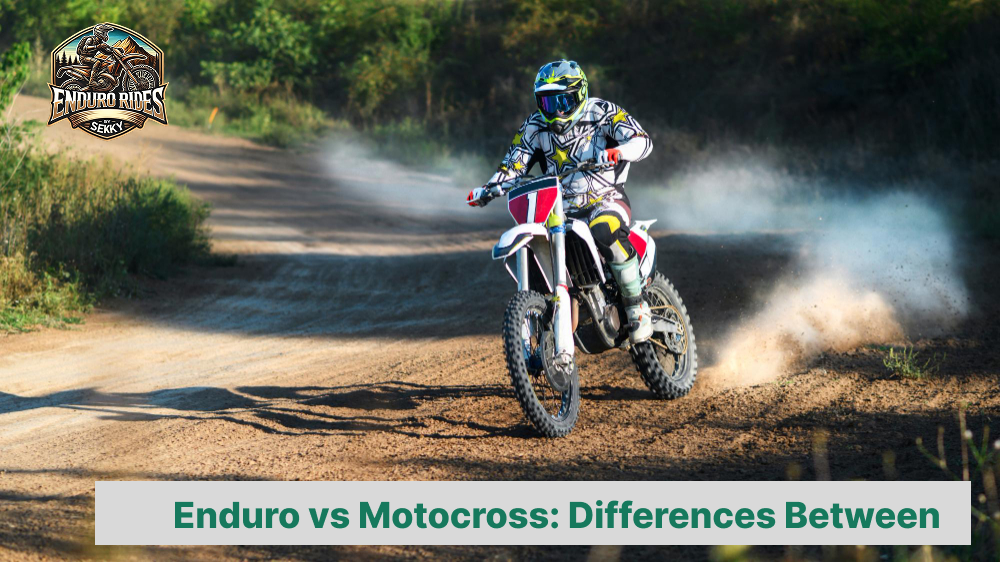
Enduro is designed for long-distance racing across natural terrain, while Motocross is designed for short, high-intensity races on closed dirt tracks. Enduro lasts several hours or even days and includes obstacles such as rocks, rivers, and forests. Motocross races are much shorter, often less than 30 minutes, and take place on standardized tracks with jumps, berms, and rhythm sections. Enduro demands stamina and navigation, while Motocross demands speed and technical control.
- What is the difference between Enduro and Motocross?
- How does Enduro compare to Motocross?
- Enduro vs Motocross: which is harder?
- Which is better: Enduro or Motocross?
- Is Enduro or Motocross better for beginners?
- Enduro vs Motocross: which is better for trails?
- Where can you ride Enduro vs Motocross?
Enduro motorcycles are built for durability and distance with larger fuel tanks, softer suspension, and protective components. Motocross motorcycles are lighter, with stiff suspension and aggressive gearing that favors quick acceleration on closed circuits. Enduro riders compete on variable terrains such as mountains, rivers, and woodland trails. Motocross riders compete on stadium and outdoor tracks with consistent artificial obstacles. Enduro tests consistency over time, while Motocross tests precision in bursts of speed.
Enduro is harder than Motocross because it combines time trials, long distances, and unpredictable terrain. Riders must endure fatigue over several hours while navigating mud, rocks, and forests. Motocross is physically intense but shorter, requiring explosive power and technical skills in jumps and corners. Enduro difficulty increases when weather conditions change mid-race, while Motocross is controlled within fixed circuits. Enduro riders rely on endurance and adaptability, while Motocross riders rely on sprint conditioning and rapid line selection.
Enduro is better for trails and outdoor terrain because its bikes are adapted with softer suspension, wider gear ratios, and larger tanks for long rides. Motocross bikes, optimized for circuits, lose efficiency on rocks, mud, and steep climbs. Enduro is practiced in countries with open landscapes, such as Bosnia, Romania, and Spain. In Bosnia, Enduro Sekky organizes tours in Uskoplje, offering guided access to forests, rivers, and Radovina mountain trails. Motocross is practiced in countries such as USA, France, and Italy, where international championships like AMA and FIM are held.
Beginners progress faster in Enduro because lower speeds on varied terrain improve balance, clutch control, and body positioning. Motocross is more dangerous for beginners due to fast-paced racing and repeated jumps. Enduro builds confidence through gradual exposure to technical climbs and long distances, such as forest trails and rocky single tracks. Motocross demands advanced reflexes, which can overwhelm inexperienced riders. Enduro is better for skill development, while Motocross becomes rewarding after mastering basics.
Motocross is more physically demanding at peak intensity because riders sustain high heart rates between 170–190 bpm with constant acceleration, braking, and jumping. Enduro is more demanding in terms of endurance because riders compete for several hours, sometimes beyond six hours, requiring aerobic stamina. Motocross requires anaerobic bursts, while Enduro requires energy management across varied terrains. Motocross is better for racing because it is designed for closed circuits and speed competition. Enduro is better for endurance competitions across forests, rivers, and mountains.
What is the difference between Enduro and Motocross?
The main difference is that Enduro is designed for long-distance off-road racing across natural terrain, while Motocross is structured for short, high-intensity races on closed dirt tracks. Enduro covers extended time durations, often lasting several hours, and tests endurance with obstacles such as rocks, rivers, and forests. Motocross focuses on speed and agility in races that typically last less than 30 minutes and take place on tracks with jumps, berms, and rhythm sections.
Enduro requires motorcycles built for durability and fuel efficiency, with features like larger fuel tanks, softer suspension, and protective components. Motocross motorcycles are lighter, with stiffer suspension and quick acceleration optimized for closed circuits. Enduro riders navigate varied environments, such as mountain trails and woodland paths, while Motocross riders compete in stadiums and outdoor tracks.
Enduro emphasizes endurance and navigation skills, making it a test of consistency across different terrains. Motocross emphasizes explosive speed and precision in short sprints, making it a test of control on technical tracks. Enduro includes time checkpoints and special test stages, while Motocross uses timed heats and finals. Both sports demand high levels of physical fitness, but Enduro riders prepare for stamina across hours, and Motocross riders train for power bursts in short intervals.

How does Enduro compare to Motocross?
Enduro is off-road motorcycle racing designed for long-distance endurance, while Motocross is motorcycle racing designed for short, high-intensity sprints on closed circuits. Enduro uses trails, forests, and natural obstacles, while Motocross uses man-made jumps, berms, and rhythm sections. Enduro emphasizes stamina and navigation skills, while Motocross emphasizes speed and technical riding control.
Enduro races take several hours or even multiple days, such as the International Six Days Enduro. Motocross races usually last 30–40 minutes per moto, such as AMA Motocross events. Enduro motorcycles use larger fuel tanks, softer suspension, and lighting systems, while Motocross motorcycles use lighter frames, stiffer suspension, and aggressive tires. Enduro riders prepare for varied terrain like rocks, rivers, and mud, while Motocross riders prepare for continuous jumps, whoops, and sharp corners.
Enduro is popular in Europe with events like the World Enduro Championship, while Motocross is popular worldwide with events like the FIM Motocross World Championship. Enduro demands endurance training, hydration, and energy management, while Motocross demands sprint conditioning, explosive strength, and technical line selection. Enduro riders adapt riding pace across different terrain types, while Motocross riders maximize acceleration and corner speed on repetitive circuits.
Enduro vs Motocross: which is harder?
Enduro is harder than Motocross because Enduro demands longer race duration, technical terrain navigation, and endurance-based performance. Motocross is shorter, faster, and requires explosive sprint skills, but Enduro tests the rider’s ability to sustain control and adapt across extended and unpredictable conditions.
Enduro racing is harder because the format combines time trials, off-road stages, and technical navigation. Riders face rocks, rivers, forests, and mud in a single race. Each obstacle demands energy management and technical precision. Motocross takes place on closed circuits with jumps and berms, where the challenge is explosive acceleration and cornering speed. Enduro tests long-term endurance, while Motocross tests short-term intensity.
Physical demands make Enduro harder than Motocross. Enduro requires stamina across several hours of competition, sometimes extending beyond six hours in professional events. Riders maintain focus and strength under fatigue, while Motocross heats last 30 to 40 minutes with recovery time between motos. In Enduro, mistakes accumulate due to mental and physical exhaustion. Motocross pushes anaerobic power, but Enduro pushes aerobic endurance.
Technical skills reinforce why Enduro is harder. Enduro riders develop versatility across terrains such as mountains, deserts, and dense woods. Examples of terrains include slippery rocks, deep sand, and river crossings. Motocross riders specialize in jumps, whoops, and rhythm sections inside a track. Enduro requires adaptability because no two sections are the same, while Motocross repeats predictable laps. Enduro difficulty increases if weather changes, since rain, snow, or heat alter the terrain conditions mid-race.
Which is better: Enduro or Motocross?
Enduro is better for riders who want endurance racing across natural terrains, while Motocross is better for riders who want short and intense races on closed circuits.
Enduro racing emphasizes long-distance endurance across forests, mountains, and trails. Enduro motorcycles use larger fuel tanks, softer suspensions, and durable tires. These modifications improve comfort and stability during races lasting several hours. Motocross racing emphasizes short, high-intensity performance on artificial tracks with jumps, bumps, and sharp turns. Motocross motorcycles use stiffer suspensions, lightweight frames, and aggressive gearing. These modifications improve acceleration and maneuverability during races lasting less than 30 minutes.
Enduro riding develops stamina and navigation skills. Riders train for hours in variable conditions, including mud, rocks, and steep hills. Examples of terrains include alpine passes, wooded trails, and desert routes. Motocross riding develops explosive speed and technical handling. Riders practice jumps, cornering, and rapid acceleration. Examples of tracks include sand circuits, clay arenas, and man-made stadium courses. The difference in terrains changes the type of skills each rider improves.
Enduro is preferred by riders who value endurance, adventure, and adaptability. Enduro competitions include the International Six Days Enduro and World Enduro Championship. Motocross is preferred by riders who value speed, precision, and controlled environments. Motocross competitions include the FIM Motocross World Championship and AMA Motocross. Both disciplines demand fitness, skill, and training, although one discipline is better for stamina and the other is better for speed. Enduro is better for endurance if long-distance performance is the priority. Motocross is better for speed if short-distance intensity is the priority.
Is Enduro or Motocross better for beginners?
Motocross is harder for beginners. Enduro is better for beginners because it develops balance, control, and endurance at lower speeds.
Motocross is high-intensity racing on closed tracks with sharp jumps and aggressive speed. Enduro is off-road riding across trails, forests, and hills with obstacles like rocks, mud, and rivers. Beginners progress more safely in Enduro because the pace is slower and the risk of falls is lower. Motocross requires strong physical conditioning and fast reflexes that beginners often lack.
Enduro improves basic skills like clutch control, throttle modulation, and body positioning. Riders practice on natural terrains, such as woods, streams, and mountain paths. These terrains teach precision handling without the high-pressure environment of racing. Motocross demands repeated jumps, rhythm sections, and whoops, which often cause injuries to new riders. Enduro reduces injury probability if a beginner learns gradually.
Beginners gain endurance and confidence faster in Enduro. They ride longer distances across varied terrains, such as dirt roads, rocky trails, and steep climbs. This variety improves adaptability to different conditions. Motocross focuses on speed and lap times, which frustrates new riders who cannot keep pace. Enduro is better for skill development, but Motocross becomes rewarding if the rider already masters basics.
Which is more physically demanding, Enduro or Motocross?
Motocross is more physically demanding than Enduro. Motocross races involve shorter tracks, higher intensity, and continuous explosive effort, which push the rider’s cardiovascular system and muscular endurance to extreme limits. Enduro requires longer duration stamina and technical skill, but the peak physical strain in Motocross is higher.
Motocross demands constant acceleration, braking, and jumping, which engage muscle groups in the arms, legs, and core. Riders sustain high heart rates averaging 170–190 bpm during a race. Enduro engages similar muscles but at a lower sustained intensity because terrain navigation distributes effort over time. Motocross forces anaerobic exertion while Enduro leans toward aerobic endurance.
Enduro vs Motocross: which requires more endurance?
Enduro requires more endurance than motocross.
Enduro races last several hours and demand continuous physical output. Motocross races are shorter in duration, usually 30–40 minutes, and focus on explosive strength and high-intensity riding. Enduro riders maintain steady cardiovascular performance across changing terrains, including forests, mountains, and rocky trails. Motocross riders sustain anaerobic bursts on closed tracks with jumps and sharp turns.
Is Enduro or Motocross better for racing?
Motocross is better for racing than Enduro because it is designed for closed circuits with short laps, high speed, and aggressive competition, while Enduro is designed for long-distance endurance, mixed terrain, and time management.
Motocross racing occurs on tracks with obstacles such as jumps, whoops, and berms. These tracks test speed, acceleration, and technical cornering. Motocross races are shorter in duration, usually 15 to 30 minutes, which favors explosive performance and sprint capacity. Enduro racing occurs on trails with natural obstacles such as rocks, rivers, and forests. Enduro races last several hours, which favors endurance, navigation, and stamina. Racing in the strict sense of head-to-head speed competition favors Motocross, while Enduro favors endurance competition if conditions extend over long time periods.
Enduro vs Motocross: which is better for trails?
Enduro is better for trails. Enduro bikes use softer suspension, lower gearing, and larger fuel tanks. These attributes allow longer riding distances and easier handling on rough terrain. Motocross bikes use stiffer suspension, higher gearing, and smaller tanks. These settings are optimized for short closed circuits with jumps and fast turns.
Enduro bikes adapt to rocks, roots, and mud on forest trails. Riders maintain control at low speed, which improves safety in technical climbs. Examples of technical climbs are rocky hill climbs, steep single tracks, and muddy descents. Motocross bikes lose traction on these surfaces because suspension and gearing are set for high acceleration and jumps.
Enduro bikes cover longer rides without frequent refueling. Fuel tanks of 8–12 liters extend range compared to motocross tanks of 5–7 liters. Riders on enduro bikes carry headlights, skid plates, and protective guards, which improve trail reliability. Motocross bikes lack these parts and break down faster on trails. Motocross is faster on circuits if terrain is smooth.
Is Enduro or Motocross better for outdoor terrain?
Enduro is better for outdoor terrain than Motocross. Enduro bikes are built for long-distance riding, uneven ground, natural obstacles, and variable surfaces, while Motocross bikes are designed for short, closed tracks with jumps and tight turns.
Enduro is designed for outdoor terrain with roots, rocks, mud, rivers, and steep hills. Enduro bikes use larger fuel tanks, softer suspension, and wider gear ratios. These attributes improve endurance, comfort, and adaptability. Motocross is designed for man-made circuits with predictable layouts, jumps, and berms. Motocross bikes use stiff suspension and lightweight frames to improve speed and acceleration.
Which discipline is better for rocky tracks: Enduro or Motocross?
Enduro is better for rocky tracks than Motocross.
Enduro is better for rocky tracks because it uses longer suspension travel, softer suspension settings, and tires designed for traction on uneven terrain. Motocross uses stiffer suspension, narrower gear ratios, and tires optimized for loose dirt, which makes it less effective on rocky ground. Rocky tracks demand stability and endurance, and Enduro bikes provide both through engine torque delivery and flexible gearing.
Enduro performs better on rocky tracks because the discipline is designed for natural obstacles, such as rocks, roots, and riverbeds. Motocross is designed for artificial tracks, such as jumps, berms, and whoops. Rocky terrain requires technical handling, low-end torque, and grip retention, which Enduro bikes achieve with softer power curves and wider-ratio transmissions. Motocross bikes lose efficiency on rocky surfaces because their gearing and suspension prioritize explosive acceleration and big jumps.
Where can you ride Enduro vs Motocross?
nduro is ridden on natural terrains such as forests, mountains, and long-distance off-road trails, while Motocross is ridden on closed circuits with artificial jumps, berms, and compact tracks. Enduro is practiced across countries with large natural landscapes, and one of the popular destinations is Bosnia.. Motocross is practiced on regulated racing circuits in countries such as France, USA, and Italy, where professional competitions are organized under international federations.
Enduro riding uses routes that cross rivers, rocky hills, and woodland areas. These routes vary in difficulty and length, such as 50 km trails in Bosnia, 100 km forest tracks in Romania, and multi-day rally stages in Spain. Motocross tracks are standardized, with typical lengths of 1.5 km to 2 km, featuring obstacles like whoops, rhythm sections, and tabletops. Enduro riding is chosen by riders who prefer endurance and navigation, while Motocross is chosen by riders who focus on speed and short races.
Is Enduro Sekky provide Enduro Bosnien Tours?
Yes. Enduro Sekky provides Enduro Bosnien tours in Uskoplje.
The tours in Uskoplje are organized for riders who want guided access to mountain trails. Enduro Sekky prepares routes that pass through forests, rivers, and rocky climbs around Gornji Vakuf-Uskoplje. These tours often include local trails across Radovina and Raduša mountains. Riders join groups where the difficulty of terrain is adapted to skill level.
The service in Uskoplje covers organized days of riding, technical guidance, and support. Groups can ride on varied terrain such as gravel roads, forest paths, and mountain ridges. Examples of tours include weekend events where foreign and domestic riders participate. This provides structured conditions for safe and demanding enduro riding.
