 Skip to content
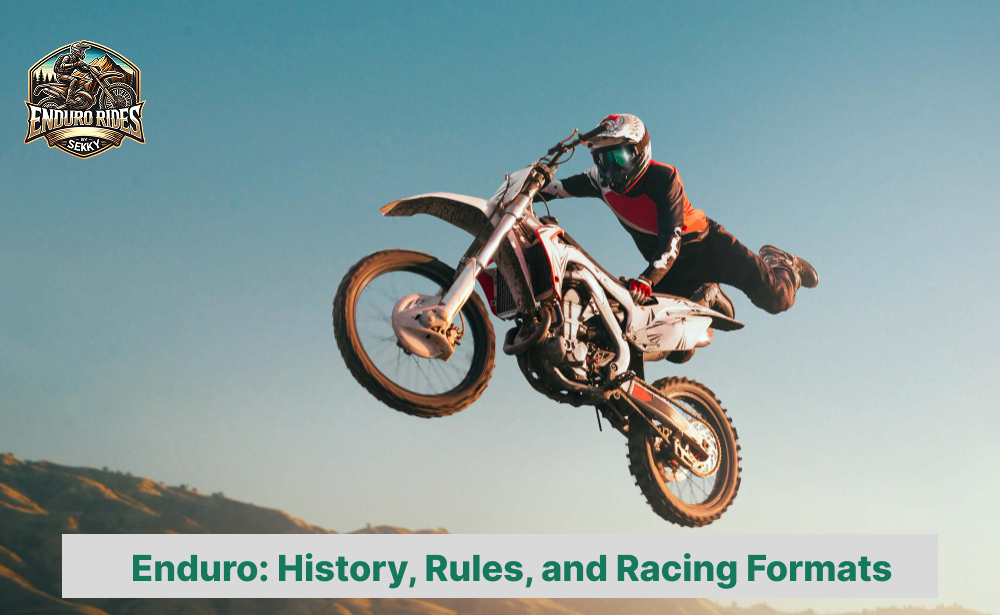
Enduro is a motorcycle discipline that combines long-distance off-road riding with timed racing. Motorcycles are built with reinforced frames, durable suspension, and strong brakes. The sport tests rider stamina and navigation across forests, rivers, rocks, and mountains. Its roots go back to early 20th century Europe, with the International Six Days Enduro in 1913 marking its formalization.
- What is enduro?
- How does enduro differ from motocross?
- What are the rules of enduro racing?
- How long does an enduro race usually last?
- How do you prepare a motorcycle for enduro?
- How do beginners start with enduro?
- What skills are needed for enduro riding?
- How physically demanding is enduro?
- What are the biggest enduro competitions in Europe?
Enduro racing uses timed special stages and untimed liaison stages. Riders pass through checkpoints, and penalties apply for late or early arrivals. Distances often exceed 200 kilometers per day, with events lasting several days. Examples include the World Enduro Championship, Erzbergrodeo, and Red Bull Romaniacs.
Enduro differs from motocross in terrain, duration, and format. Enduro runs on natural trails such as forests and rivers, while motocross uses short man-made tracks with jumps and berms. Enduro motorcycles use larger fuel tanks, softer suspension, and headlights, while motocross bikes are lighter with stiffer setups. Enduro emphasizes endurance, while motocross emphasizes speed.
Enduro rules regulate timing, course following, motorcycles, and safety. Riders face penalties for missing checkpoints, shortcuts, or arriving outside time limits. Motorcycles must meet standards for noise, displacement, and lighting. Protective equipment such as helmets, gloves, boots, and chest protectors is mandatory. Riders are penalized for dangerous riding, tampering, or disrespecting officials.
Enduro races last 2 to 8 hours, depending on category. Amateur events last 2 to 4 hours, while professional races last 5 to 8 hours. International events like the ISDE extend over 6 days, with total riding time exceeding 30 hours. Formats combine laps, stages, and checkpoints.
Preparation involves suspension adjustment, installation of protective guards, tire optimization, and gearing adaptation. Riders check controls and equip safety gear. Tires with deep knobbies such as Michelin Enduro Medium are paired with mousse inserts. Skid plates, radiator braces, and handguards protect key components.
Reliable brands include KTM, Husqvarna, Honda, Yamaha, Beta, and Sherco. KTM models like the 300 EXC TPI are common in professional races. Husqvarna TE 300i, Honda CRF450RX, Yamaha WR450F, Beta RR 300, and Sherco 300 SE Factory are known for durability and consistent results in hard enduro competitions.
Enduro requires full protective sets including helmets, goggles, gloves, boots, jerseys, pants, chest protectors, knee guards, elbow guards, and neck braces. Examples include Alpinestars Tech 7 boots, Oakley Airbrake goggles, and Leatt braces. These reduce injury risks from impacts, abrasion, and debris.
Beginners start with light motorcycles, such as KTM EXC 125 or Honda CRF250F. They wear full protective gear and train basic skills like braking, throttle control, and body balance. Riders progress from flat dirt tracks to forest paths and join local clubs or training groups. Regular maintenance of the motorcycle is essential.
Skills include balance, throttle and clutch control, braking precision, and terrain reading. Riders must sustain endurance and strength for multi-hour races. Examples include controlling traction on slippery rocks, braking on downhill descents, and negotiating obstacles like logs and boulders.
Enduro is physically demanding, requiring cardiovascular endurance, muscular strength, and fast reflexes. Riders burn 600–1,000 kcal per hour, similar to elite cycling. Forearm pump, lactic acid buildup, and dehydration are common. Grip strength, neuromuscular control, and balance determine safe riding across technical terrain.
The biggest European events are the EnduroGP World Championship, International Six Days Enduro, and the Hard Enduro World Championship. The EnduroGP crowns the season’s world champion. The ISDE brings national teams from more than 30 countries. Hard Enduro races include Erzbergrodeo, Red Bull Romaniacs, and Hixpania.
The Balkans offer prime enduro trails in Bosnia, Montenegro, and North Macedonia. Enduro Bosnia includes Bjelasnica, Jahorina, and Igman. Montenegro highlights Durmitor, Lovćen, and Komovi. North Macedonia features Šar Mountains, Pelister, and Vodno. Trails vary from forest single-tracks to alpine ridges and glacial valleys.
What is enduro?
Enduro is a motorcycle sport that combines long-distance off-road riding with time-controlled racing. Enduro uses motorcycles designed for endurance, featuring durable suspension, reinforced frames, and strong braking systems. The discipline tests rider stamina and navigation accuracy across natural terrain. Enduro takes place on trails, forests, and mountains where obstacles include mud, rocks, and rivers. Enduro began in Europe during the early 20th century and became formalized through the International Six Days Enduro in 1913.
Enduro racing is structured around stages where riders complete timed sections under strict schedules. Racing uses checkpoints to measure both speed and consistency, and penalties apply for late or early arrivals. Enduro events can last for several days, with daily distances often exceeding 200 kilometers. Examples of modern enduro events include World Enduro Championship, Red Bull Romaniacs, and Erzbergrodeo. These events require physical endurance and technical riding skills.
Enduro motorcycles differ from motocross motorcycles in features like larger fuel tanks, wider gear ratios, and headlamps for extended riding. Manufacturers include KTM, Husqvarna, Honda, and Yamaha. Riders prepare through conditioning, navigation training, and terrain adaptation. Enduro supports categories for professionals, amateurs, and veterans, ensuring structured competition. Riders maintain safety with protective equipment such as helmets, body armor, and boots. Enduro continues to expand globally with growing participation if terrain regulations permit.
How does enduro differ from motocross?
Enduro differs from motocross in terrain, duration, and competition format. Enduro is an off-road motorcycle discipline that takes place on long natural routes with forests, rivers, and rocky trails. Motocross is a closed-circuit sport that runs on short man-made tracks with jumps, berms, and obstacles. Enduro emphasizes endurance across hours of riding, while motocross emphasizes speed in short races that usually last less than 30 minutes.
Enduro uses time checks, liaison sections, and special stages. Riders pass through timed control points and complete technical sections, such as steep climbs, water crossings, and logs. Motocross uses heats, motos, and finals. Riders complete laps with high acceleration and controlled landings from jumps. Enduro motorcycles are built with larger fuel tanks, softer suspension, and headlights. Motocross motorcycles are lighter with stiff suspension, small fuel tanks, and no headlights.
Enduro competitions include races such as International Six Days Enduro or Hard Enduro events like Erzbergrodeo. Motocross competitions include FIM Motocross World Championship or AMA Motocross. Enduro riders cover many kilometers in a single event, while motocross riders cover short distances at higher speed. Enduro focuses on resilience in natural terrain, while motocross focuses on performance in artificial circuits. Both sports use protective equipment such as helmets, boots, and guards, with variations adapted to terrain conditions.
What are the rules of enduro racing?
Enduro racing is governed by strict rules that regulate timing, route following, equipment standards, and rider conduct. These rules ensure fairness, rider safety, and reliability of results.
Main Rules of Enduro Racing
1. Timing Rules
Races are divided into timed special stages and untimed liaison stages. Timed stages determine the ranking. Liaisons must be completed within a set time limit, for example 20 minutes between checkpoints. Riders are penalized for arriving too early or too late at time controls.
2. Course and Route Rules
Riders must follow the marked course. Missing checkpoints, cutting the track, or taking shortcuts leads to penalties or disqualification. Organizers mark routes with arrows, tape, or flags to guide participants through forests, mountains, or mixed terrain.
3. Motorcycle Regulations
Motorcycles must comply with technical standards such as engine displacement, sound levels, and safety equipment. For example, FIM rules set the maximum noise limit at 112 dB for 2-stroke engines and 114 dB for 4-stroke engines. All bikes must have functioning lights, number plates, and approved exhaust systems.
4. Protective Equipment Rules
Riders must wear certified helmets, gloves, boots, chest protectors, and goggles. Examples of approved gear include FIM-homologated helmets and CE-certified protective armor. Non-compliance leads to exclusion from the race.
5. Conduct and Penalties
Riders must respect other competitors, officials, and the environment. Dangerous riding, unsportsmanlike behavior, or tampering with time cards leads to time penalties or disqualification. Penalties can range from 1-minute additions to complete race exclusion.
How long does an enduro race usually last?
An enduro race usually lasts between 2 hours and 8 hours. Race formats vary by type, location, and organization. Short races last 2 hours, medium races last 4 hours, and long races last 6 to 8 hours. International enduro events often extend over several days, such as 3 days, 5 days, or 6 days. Race durations are measured in minutes, hours, and days, depending on the category.
The duration of enduro races depends on terrain, route length, and competition class. Amateur races last 120 minutes to 240 minutes. Professional championships last 300 minutes to 480 minutes. Multi-day races last 72 hours, 120 hours, or 144 hours in total. Famous events, such as the International Six Days Enduro, last 6 days. These time ranges are common across European, American, and World Enduro Championship events.
Race organizers define length by combining laps, stages, and checkpoints. One lap may take 20 minutes, 40 minutes, or 60 minutes to complete. Races require competitors to finish multiple laps. Enduro series often require 3 hours, 5 hours, or 7 hours of riding per day. When multi-day formats apply, total riding time can exceed 20 hours, 30 hours, or 40 hours in aggregate. Variations exist across national championships, such as AMA Enduro in the USA or FIM World Enduro Championship in Europe, if regulations extend total distance.
How do you prepare a motorcycle for enduro?
To prepare a motorcycle for enduro, the rider adjusts suspension, protects critical parts, optimizes tires, checks controls, adapts gearing, and equips safety gear.
Stages with Explanations
- Suspension Adjustment
The rider sets front and rear suspension for rough terrain. Fork compression and rebound are balanced for stability. Shock preload is adjusted to support rider weight. Damping is increased to absorb jumps and rocks. - Protection Installation
The motorcycle receives guards for engine, radiator, and hand controls. A skid plate covers the frame underside. Handguards protect levers from rocks and branches. Radiator braces prevent punctures. - Tire Optimization
Enduro requires tires with deep knobbies, such as Michelin Enduro Medium or Metzeler Six Days. Tires are paired with heavy-duty tubes or mousse inserts. Tire pressure is lowered for traction on mud, sand, and rocks. - Control Check
Levers, throttle, and clutch are adjusted for quick reach. Handlebars are aligned with rider preference. Brake pads and cables are inspected for response. Cables are lubricated to prevent sticking. - Gearing Adaptation
The sprocket ratio is modified for torque. A smaller front sprocket or larger rear sprocket improves acceleration. Chain tension is checked after changes. - Safety Equipment
The rider equips body armor, boots, and helmet. Neck braces and knee braces protect from injuries. Hydration packs are added for long stages. Tools and spare parts, such as spark plugs and tire levers, are carried.
Which brands make the most reliable enduro motorcycles?
The most reliable enduro motorcycles are made by KTM, Husqvarna, Honda, Yamaha, Beta, and Sherco. These brands dominate endurance racing, maintain high durability scores, and offer strong engine reliability across both 2-stroke and 4-stroke categories.
Reliable Enduro Motorcycle Brands and Models
1. KTM
KTM produces some of the most reliable enduro motorcycles. The KTM EXC-F 350 is reliable for its balance of engine performance and lightweight design. The KTM 300 EXC TPI is reliable for long-distance rides with strong torque delivery. KTM reliability is reinforced by success in professional enduro competitions, such as the EnduroGP World Championship.
2. Husqvarna
Husqvarna shares technology with KTM but adds unique chassis and suspension setups. The Husqvarna TE 300i is reliable for technical terrain and demanding off-road racing. The Husqvarna FE 350 is reliable for versatile riders, providing endurance without high maintenance intervals. Husqvarna reliability is proven by consistent podium finishes in hard enduro events.
3. Honda
Honda builds durable 4-stroke enduro motorcycles. The Honda CRF450RX is reliable for competitive racing and cross-country use. The Honda CRF250RX is reliable for riders who prefer lighter handling with strong endurance performance. Honda reliability comes from long engine service life and global parts availability.
4. Yamaha
Yamaha produces reliable enduro motorcycles based on their motocross platforms. The Yamaha WR450F is reliable for desert races and long rally stages. The Yamaha WR250F is reliable for single-track trails and technical climbs. Yamaha reliability is supported by robust engines and wide dealer networks worldwide.
5. Beta
Beta specializes in enduro motorcycles with Italian engineering. The Beta RR 300 is reliable for hard enduro racing due to its smooth power delivery. The Beta RR 390 4T is reliable for longer trail rides with reduced rider fatigue. Beta reliability is strengthened by adjustable suspension and competitive race support.
6. Sherco
Sherco builds reliable enduro motorcycles with strong racing pedigree. The Sherco 300 SE Factory is reliable for extreme off-road endurance. The Sherco 250 SEF is reliable for intermediate riders who want balance between power and control. Sherco reliability is proven by professional riders in events such as the Erzbergrodeo.
What protective gear is required for enduro?
rotective gear for enduro is full body protection equipment designed for off-road riding. Riders use helmets, goggles, gloves, boots, jerseys, pants, chest protectors, knee guards, elbow guards, and neck braces. Each element protects against impact, abrasion, and environmental hazards.
List of Required Gear with Explanations
- Helmet – A full-face helmet with chin guard protects the head and face. Off-road helmets are ventilated and lightweight, and they are paired with goggles for vision clarity.
- Goggles – Goggles protect eyes from dust, stones, and branches. Models such as Oakley Airbrake and 100% Armega are common examples.
- Gloves – Gloves protect hands from blisters, vibration, and abrasions. They use reinforced palms and knuckle padding.
- Boots – Enduro boots protect feet, ankles, and shins from impact and twisting. Brands like Alpinestars Tech 7 or Sidi Crossfire are used examples.
- Jersey and Pants – Jerseys and pants use abrasion-resistant textiles. They allow airflow and mobility while resisting tearing from branches or falls.
- Chest Protector – A chest protector shields ribs, sternum, and back from roost, impacts, and falls. Variants include hard-shell armor and soft foam armor.
- Knee Guards – Knee guards prevent hyperextension and protect patella and ligaments. Riders often use Leatt or Pod knee braces.
How do beginners start with enduro?
- Elbow Guards – Elbow guards protect joints from direct impact and sliding injuries. Lightweight plastic and foam constructions are standard.
- Neck Brace – A neck brace limits cervical spine rotation and reduces risk of spinal injury. Leatt neck brace is a known example.
Protective gear increases survival and reduces injury probability in enduro riding. Helmets, boots, and chest protectors carry the highest protective value. Goggles, gloves, and guards improve comfort and reduce secondary injuries. Jerseys and pants add abrasion resistance and are required for competitive racing.
How do beginners start with enduro?
Step 1: Select the right motorcycle
Beginners start with an entry-level enduro motorcycle that has lower engine displacement. A 125cc or 250cc model is light and easy to control. Lightweight models reduce fatigue and help riders focus on technique. Examples of entry-level motorcycles are KTM EXC 125, Yamaha WR250F, and Honda CRF250F.
Step 2: Wear full protective equipment
Protective equipment is essential for safety in enduro. A helmet, goggles, gloves, boots, and body armor protect against falls and debris. Protective sets increase confidence and reduce injury risk. Examples of equipment are Airoh Aviator helmets, Alpinestars Tech 7 boots, and Leatt body protectors.
Step 3: Train basic riding skills
Riders practice balance, throttle control, braking, and standing position on simple terrain. Skills training improves body control and stability on rough ground. Training areas include flat dirt tracks, forest trails, and small hills.
Step 4: Gradually enter natural terrain
After basic control, riders start on easy forest paths and gravel roads. Progression to rocks, mud, and steep climbs comes only after mastering balance. Riding on gradual terrain builds confidence and prepares for technical obstacles.
Step 5: Join training groups
Beginners improve faster in groups with experienced riders. Riding groups provide advice, demonstrate techniques, and set pace. Examples of training groups are local enduro clubs, motocross schools, and regional rider associations.
Step 6: Maintain the motorcycle regularly
Enduro motorcycles require frequent maintenance because of rough conditions. Oil changes, chain checks, and brake inspections keep the motorcycle reliable. Maintenance extends lifespan and improves riding safety.
What skills are needed for enduro riding?
Enduro riding requires physical fitness, technical control, balance, endurance, and terrain reading. Riders use skills such as throttle control, clutch modulation, braking precision, and body positioning.
Skills for Enduro Riding with Explanations:
- Balance and Body Positioning
Balance improves stability in rough terrain. Riders shift weight forward or backward depending on slope angle. Examples include steep uphill climbs and deep ruts. - Throttle and Clutch Control
Throttle control regulates traction on surfaces. Clutch control maintains engine momentum at low speeds. Examples include slippery rocks and muddy tracks. - Braking Precision
Braking precision reduces sliding and maintains traction. Riders apply front brake for strong stopping and rear brake for stability. Examples include downhill descents and sharp turns. - Line Selection and Terrain Reading
Line selection improves efficiency across obstacles. Terrain reading anticipates grip changes. Examples include tree roots, loose gravel, and river crossings. - Endurance and Strength
Endurance sustains long rides. Strength stabilizes the motorcycle during impacts. Examples include long enduro races and multi-hour trail rides. - Obstacle Negotiation
Obstacle negotiation combines wheel lifts, pivots, and controlled acceleration. Riders apply front wheel lift for logs and controlled throttle for rock steps. Examples include fallen trees and boulder fields.
How physically demanding is enduro?
Enduro is physically very demanding because it requires prolonged endurance, high strength, fast reflexes, and sustained focus over long riding stages. Riders maintain elevated heart rate levels for hours and exert large muscle groups in both upper and lower body during technical terrain.
Enduro demands cardiovascular endurance because riders sustain intensity for several hours, often between 4 and 7 hours in competitive formats. Riders perform repeated accelerations, steep climbs, and downhill sections that elevate oxygen consumption. Muscular endurance is critical because forearm muscles, leg muscles, and core muscles stabilize the bike through rocks, roots, and drops. Energy expenditure is high, with calorie burn ranging between 600 and 1,000 kcal per hour in measured cases, similar to values seen in professional cycling or motocross.
Enduro requires neuromuscular control because riders process rapid changes in terrain such as loose gravel, mud, or tree roots. Reflexes determine safety during sudden braking or steering corrections. Grip strength and balance are decisive in preventing fatigue-related mistakes. The combination of strength, coordination, and stamina makes it one of the most physically demanding disciplines in off-road motorsports. Examples of physical demands include repeated sprints, arm pump in forearms, lactic acid buildup in legs, and dehydration risk during hot races.
What are the biggest enduro competitions in Europe?
The biggest enduro competitions in Europe are the FIM EnduroGP World Championship, the International Six Days Enduro (ISDE), and the Hard Enduro World Championship. The EnduroGP World Championship takes place annually across multiple European countries such as Italy, Portugal, and France. The ISDE is the oldest enduro event in the world, founded in 1913, and it rotates hosting nations across Europe, for example Spain, Slovakia, and Italy. The Hard Enduro World Championship includes extreme races such as Erzbergrodeo in Austria, Red Bull Romaniacs in Romania, and Hixpania Hard Enduro in Spain.
These competitions attract the best professional riders and teams from Europe and outside Europe. The EnduroGP World Championship is known for multi-day events on varied terrain such as forests, mountains, and riverbeds. The ISDE gathers national teams from more than 30 countries, including France, Great Britain, and Sweden, competing under the same rules for six consecutive days. The Hard Enduro World Championship focuses on extreme endurance, with races featuring rock climbs, steep hills, and man-made obstacles. Examples of extreme races are Erzbergrodeo with over 1500 participants, Red Bull Romaniacs with stages in Carpathian mountains, and Sea to Sky in Turkey.
These competitions define the calendar of enduro sport in Europe. The EnduroGP World Championship crowns the official world champion each season. The ISDE determines the strongest national teams based on combined time results. The Hard Enduro World Championship ranks the best extreme riders by performance in selected races. The scale of these events makes them central reference points for international riders, manufacturers, and sponsors. These races set performance standards and determine career success if a rider achieves podium results.
What are the best trails for enduro in the Balkans?
The best trails for enduro in the Balkans are concentrated in Bosnia, Montenegro, and North Macedonia. Enduro Bosnia is a recognized destination because its trails in Bjelasnica, Jahorina, and Igman mountains combine natural stone paths, forest single-tracks, and steep ascents. Bjelasnica trails measure over 50 kilometers and include rock gardens, river crossings, and technical climbs. Jahorina trails include alpine ridges, gravel descents, and sections with panoramic views over Sarajevo. Igman trails are shorter but contain dense forest single-tracks, narrow switchbacks, and steep drops.
Montenegro trails are ranked high for endurance riders because of Durmitor, Lovćen, and Komovi. Durmitor trails feature high-altitude rocky sections, glacial valleys, and alpine ridges. Lovćen trails are known for limestone surfaces, hairpin climbs, and sharp descents. Komovi trails contain forest ridges, river crossings, and steep gravel paths. North Macedonia adds popular trails in Šar Mountains, Pelister, and Vodno. Šar Mountains trails include long technical ascents, alpine lakeside routes, and stone-covered ridges. Pelister trails contain granite rock sections, forest downhill lines, and old shepherd paths. Vodno trails are accessible directly from Skopje and combine steep enduro climbs, rocky descents, and technical drops.
The Balkans as a region provide enduro trails with unique terrain variations, from alpine ridges in Bosnia to limestone slopes in Montenegro and granite rock sections in North Macedonia. Riders benefit from different trail types such as forest single-tracks, rocky alpine passes, and glacial valleys. Examples include Bjelasnica in Bosnia, Durmitor in Montenegro, and Pelister in North Macedonia. These examples reinforce enduro Bosnia as a central hub while showing strong regional connections if riders extend tours to neighboring countries.
